XPENG Scores Record Funding to Fast-Track IRON Humanoid Robot
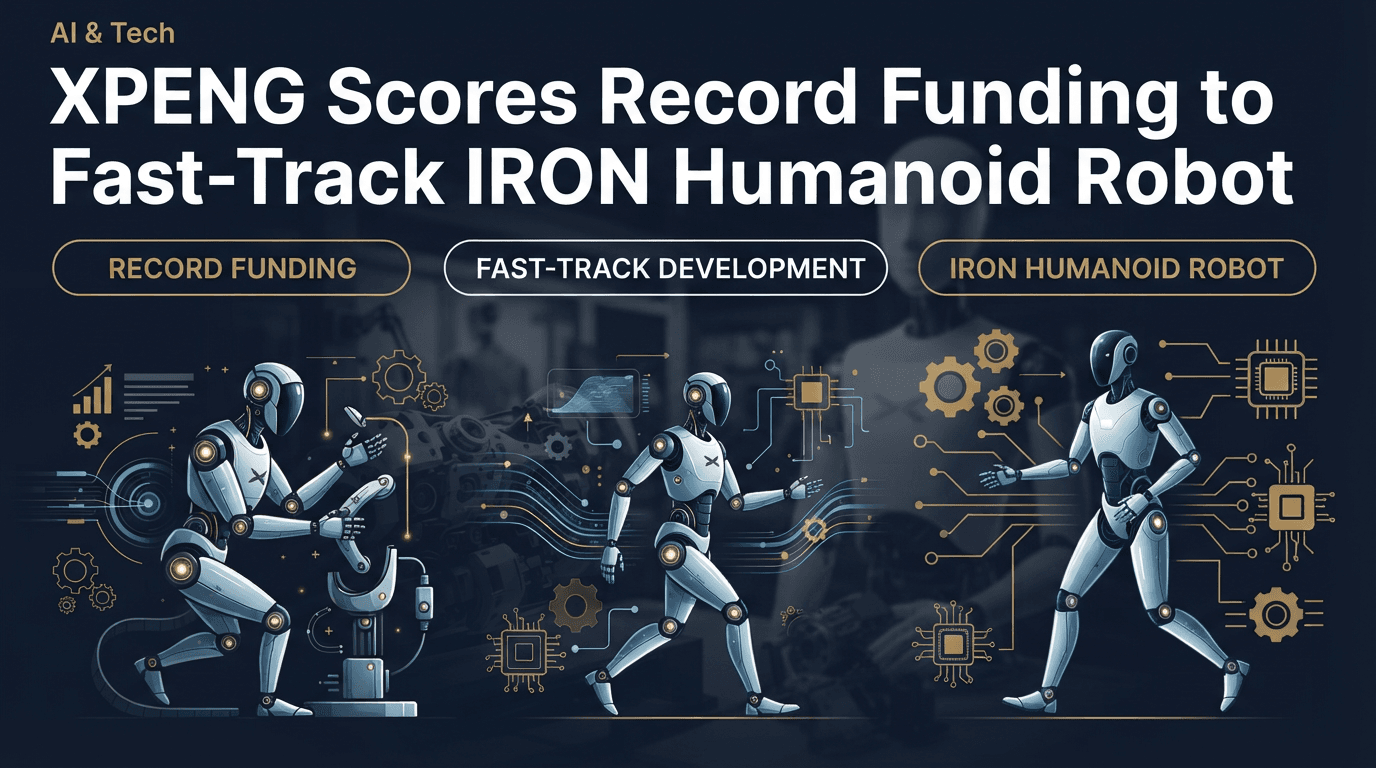
Chinese automaker and robotics player XPENG has raised more than US$900 million for its humanoid robotics business, setting a new record for a single private financing round in China’s fast‑growing embodied or “physical AI” sector. The capital will accelerate development and mass production of the company’s flagship humanoid robot, IRON, and push XPENG’s robotics arm toward global commercialization from 2027.
Landmark funding round values robotics unit at over $6.3 billion
XPENG announced on 24 August 2026 that its carved‑out robotics business has signed equity financing agreements with a group of prominent investors, securing over US$900 million in its first external funding round at a post‑money valuation above US$6.3 billion. The company describes the deal as the largest single private‑equity raise to date in China’s embodied AI industry, underscoring how quickly capital is flowing into robots that can interact with the physical world.
The round is led by IDG Capital, with participation from Chinese venture firm Gaorong Ventures and strategic backing from internet heavyweights Tencent and Alibaba. XPENG will retain control of the robotics unit, which encompasses the IRON humanoid platform as well as quadruped and other general‑purpose robot systems.
Funding aimed at scaling IRON and XPENG’s physical AI stack
XPENG says the fresh capital will be used across the full stack of what it calls physical AI—embodied intelligence that connects large‑scale AI models to real‑world robotic hardware. Priority areas include:
- Hardware and software R&D for humanoid and other general‑purpose robots.
- Training and iteration of physical AI models, including perception, planning and control systems for complex, unstructured environments.
- High‑quality data collection from simulations and real‑world deployments to refine the robots’ capabilities.
- End‑to‑end mass‑production facilities, enabling high‑volume manufacturing of IRON units.
- Global commercial expansion, with an eye on both domestic Chinese and overseas markets from 2027 onward.
Industry observers note that the combination of large‑scale AI training, advanced mechatronics and automotive‑grade manufacturing is becoming a central competitive battleground as companies race to turn humanoid robots from research projects into commercial products.
Inside IRON: XPENG’s next‑generation humanoid
XPENG first unveiled the next‑generation IRON humanoid robot in late 2025. The system is designed as a general‑purpose platform capable of operating in environments such as factories, logistics hubs, retail spaces and eventually public settings.
Key disclosed specifications for IRON include:
- 76 degrees of freedom (DoF) across the body, allowing fluid whole‑body motion.
- 21 DoF per hand, enabling fine manipulation tasks such as grasping tools, handling packages or operating controls.
- Onboard compute powered by three in‑house “Turing” AI chips, delivering up to 2,250 TOPS (trillions of operations per second) to run perception and control models locally.
This technical configuration is intended to support complex tasks with low latency and limited reliance on cloud connectivity, a key requirement for industrial settings and safety‑critical applications. XPENG frames IRON as a general‑purpose platform that can be upgraded through software and model updates over time.
From prototype to production: mass rollout targeted from 2026
XPENG plans to begin mass production of IRON by the end of 2026. The company has already announced a dedicated humanoid robot manufacturing base in Guangzhou, set to support large‑scale production. Earlier guidance from XPENG executives and robotics analysts pointed to a target of more than 1,000 IRON units per month once the factory reaches steady‑state output.
Initial deployments are expected at XPENG’s own retail stores and industrial campuses, where the company can tightly control operating conditions and use IRON as both a customer‑facing showcase and an internal productivity tool. Use cases may include greeting visitors, demonstrating vehicle functions, performing inventory checks, or handling repetitive tasks within warehouses and production lines.
XPENG aims to move from internal pilots to commercial sales and deliveries in 2027, first in China and then in overseas markets. The newly raised funding is intended to bridge the gap between prototype demonstrations and sustained commercial deployment at scale.
XPENG positions itself as a “physical AI” leader
The record‑setting round solidifies XPENG’s ambition to position itself not only as an electric vehicle manufacturer but also as a leading physical AI company. By carving out its robotics arm and securing external capital while retaining control, XPENG is following a playbook similar to other major technology companies that spin off high‑growth divisions to sharpen focus and unlock value.
In corporate statements, XPENG highlights that the size of the funding and the valuation achieved reflect investors’ confidence in its technology roadmap, manufacturing capabilities and long‑term business prospects in embodied AI. The company has previously outlined multiyear investment plans totaling tens of billions of dollars to build up its robotics ecosystem, spanning chips, algorithms, cloud infrastructure and factory capacity.
Competitive landscape and strategic implications
XPENG’s IRON project is part of a broader global race to bring humanoid robots into mainstream commercial use. Automakers and technology firms in the United States, Europe and Asia are all investing heavily in humanoid platforms, banking on synergies between autonomous driving, robotics and AI infrastructure.
In China, XPENG’s record round raises the stakes for local rivals in both the robotics and EV sectors. The participation of Tencent and Alibaba signals that major internet platforms view physical AI as a strategic frontier that could reshape logistics, retail and cloud‑based AI services. For XPENG, the backing of such partners could pave the way for deep integrations between IRON and digital ecosystems spanning payments, e‑commerce and consumer apps.
Analysts say the key challenges ahead will include ensuring safety and reliability in real‑world deployments, driving down unit costs through manufacturing scale, and proving clear productivity gains for early customers. If XPENG can deliver on its timelines—mass production in 2026 and commercial rollout in 2027—the IRON humanoid could become one of the first large‑scale, general‑purpose humanoid platforms on the market, and the latest funding round suggests that investors are betting heavily on that outcome.